
Why Substack Can Be Useful for People Who Live and Write About Second Life
Why a quieter, writer-friendly platform may offer Second Life creators a better way to share ideas, build an archive, and stay connected beyond the noise of social media.

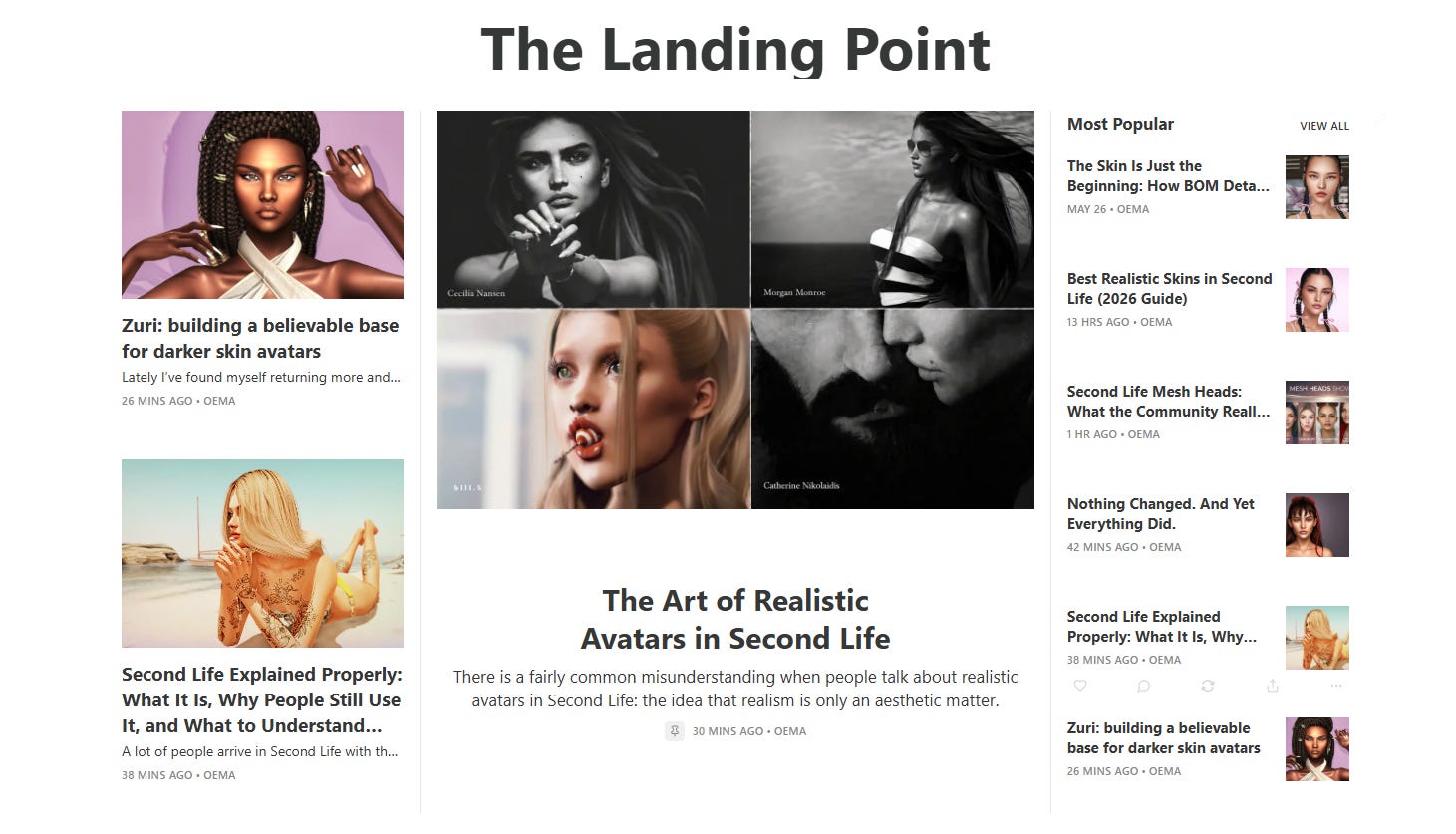
Lately, I have started using Substack more and more intentionally. Not because I think it is the perfect platform, and not because I believe it should become the new reference point for everyone. Each person chooses the tools that best fit the way they communicate, the audience they want to reach, and the kind of content they want to create.
Still, I do believe Substack can be an interesting opportunity for people who spend time in Second Life — especially for those who do not want to limit themselves to posting images, vendors, events, or quick updates, but still feel the need to write, reflect, tell stories, and build a personal archive of thoughts and content.
This reflection comes from my own experience. I started my journey in Second Life by writing, mostly about art, and later expanded into other topics as well. Writing has always remained an important part of what I do and of the way I exist within this virtual world. To me, Second Life has never been only a visual platform. It has also always been a place of observation, narration, identity, relationships, aesthetics, and experimentation.
And when you truly need to write, sooner or later you realize that social media is not enough.
The Problem for Writers: Having a Home
People who love writing need a home. Not necessarily a complex, perfect home designed down to the smallest detail, but a stable place where texts can remain, be read, found again, and shared.
Social media is useful, of course. Facebook allows even long posts, X is fast but limited, Instagram is extremely powerful for images and videos, and Flickr still plays an important role in Second Life’s visual culture. But none of these platforms is truly designed to host an editorial journey.
A social media post lives briefly. It is seen, perhaps commented on, and then disappears into the stream. Even when it technically remains available, it is hard to find again, hard to organize, and hard to turn into a coherent archive.
That is why, like many other people who write, I have felt the need over time to have a blog. A domain, a space of my own, a site built around my content. It is a natural choice: if you write, you want a place where texts are not just “posts,” but articles. You want to be able to organize them, connect them, update them, and let them breathe.
The problem is that a traditional blog, especially one built with WordPress, requires far more energy than it seems at first.
When Technical Management Steals Space from Writing
Having a personal blog is wonderful, but it comes with an enormous amount of invisible work. You have to choose a hosting provider, install WordPress, configure a theme, look for plugins, update them, fix incompatibilities, optimize images, check site speed, customize CSS, and solve small technical problems that always seem harmless at first and then end up consuming half a day.
Of course, all of this can also be interesting. Some people enjoy working on the technical and visual side of their website. In some ways, I have always found it stimulating too. The problem begins when managing the tool starts to consume the time and energy that should go into writing.
At some point, you realize you are no longer thinking about the next article, but about the homepage layout. You are no longer developing an idea, but trying to understand why a plugin is slowing down the site. You are no longer writing, but moving blocks, adjusting previews, correcting margins.
And slowly, the pleasure of writing becomes tangled with technical fatigue.
For me, this was one of the central issues. I had not stopped having ideas. I had not stopped wanting to write. But every article carried with it an additional workload that ended up slowing me down.
From this point of view, Substack struck me precisely because it drastically reduces the technical noise. It does not remove every limitation — quite the opposite: it does not offer the same visual freedom as a fully customized website. But in exchange, it allows you to do something very simple and increasingly rare: open a page and write.
The Language Question
There is another important aspect, especially for anyone writing about Second Life: language.
Second Life is an international community. Even when you start from an Italian experience, it is natural to want to reach people who speak English or belong to other language communities. For a long time, this was complicated. Writing in English, for someone who did not have full command of the language, meant relying on translators that were often rigid, unnatural, and unable to preserve tone, nuance, and intention.
Today, things have changed. Artificial intelligence has made translation much more effective, especially when the goal is not simply to convert words, but to preserve style, rhythm, and meaning. Substack also offers integrated features that make reading and translating content easier.
On a traditional blog, managing a multilingual structure properly means using plugins, configurations, different versions of articles, SEO considerations, and compatibility between themes and translation tools. It is all possible, but it adds another layer of complexity.
For those who mainly want to write, having a platform that simplifies this step is a huge advantage. Not because it replaces editorial work, but because it lowers the barrier to entry. It allows you to focus on the content rather than on the machine that distributes it.
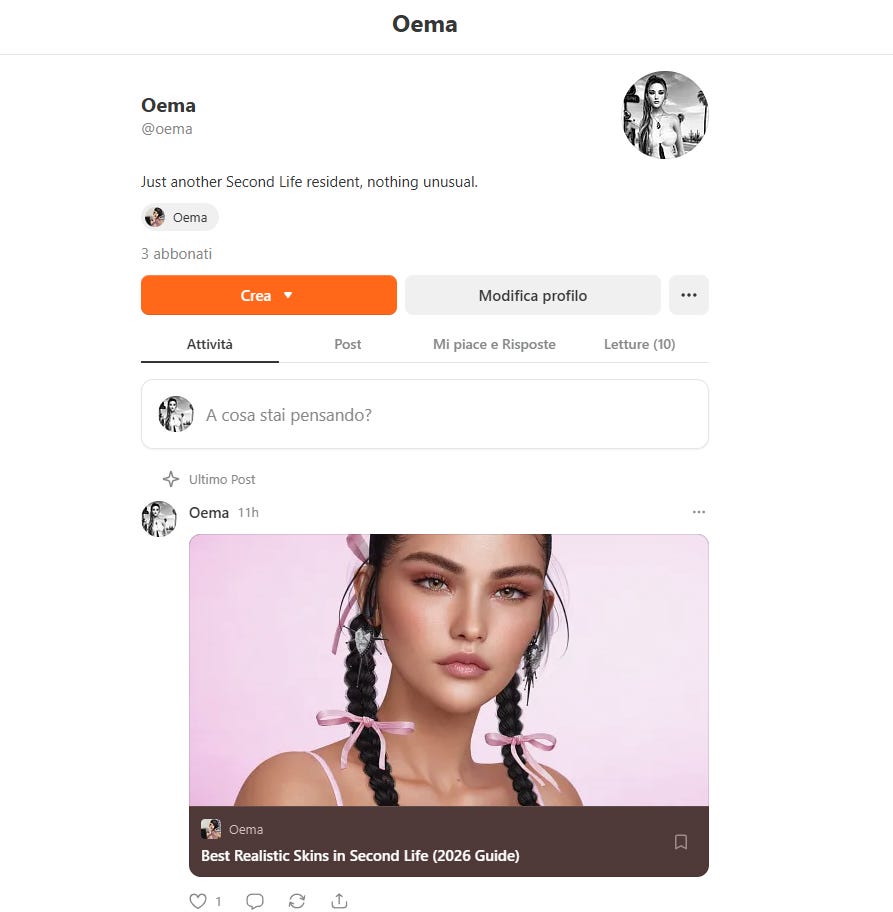
Publishing Is Not Enough: People Need to Find You
Another issue, perhaps even more frustrating, is sharing.
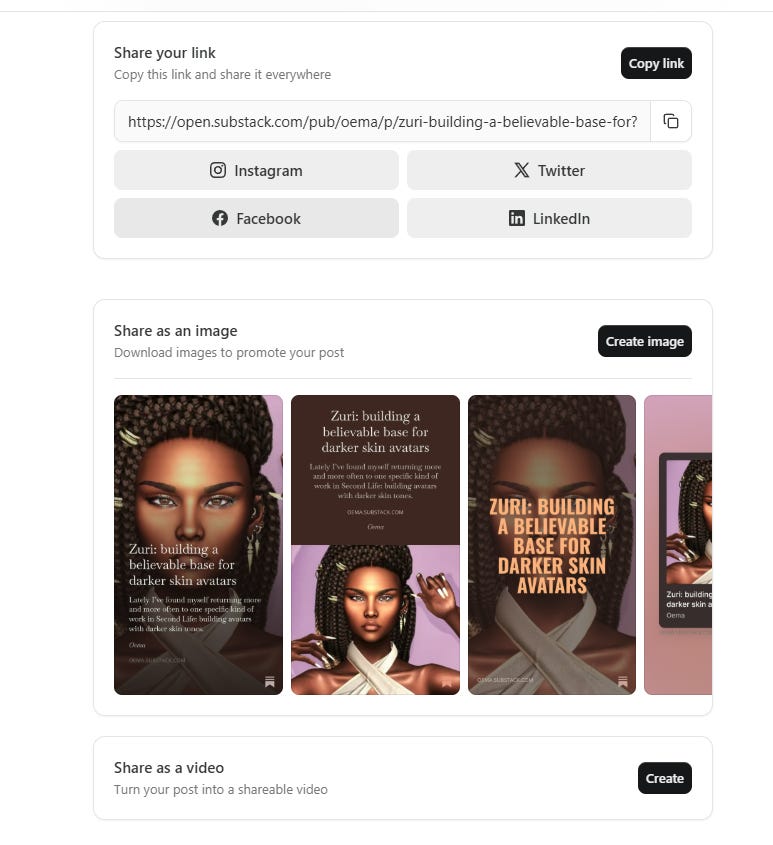
Writing an article is only half the work. After publishing it, you have to make sure it reaches people. This means sharing it on Facebook, X, Instagram, groups, communities, Discord, Flickr, personal profiles, and dedicated pages. Anyone who creates content in Second Life knows this very well: visibility does not arrive on its own.
The problem is that algorithms reward constant presence, not necessarily quality. If you publish rarely, if you do not interact enough, if you are not constantly visible, you are easily buried. You may write a carefully crafted, useful, thoughtful article — but if you do not promote it properly, very few people may ever see it.
This mechanism can become exhausting. Every piece of content requires a small promotional campaign. Every article has to be relaunched, adapted, explained, and reposted. And so, once again, the work surrounding writing becomes heavier than the writing itself.
Substack does not magically solve the visibility problem. It would be naïve to think so. You still need to build an audience, share your work, and make yourself known. But it changes the dynamic: at the center there is not only the algorithm, but a direct relationship with the people who choose to subscribe.
The Strength of the Newsletter
The newsletter is, in my opinion, one of the most important aspects of Substack.
When someone subscribes, they are doing something different from simply liking a post. They are saying: this content interests me enough that I want to receive it. I do not want to hope the algorithm shows it to me. I want it to come directly to me.
For a writer, this difference is huge.
A newsletter creates a more stable relationship with the reader. You are not completely dependent on the social media stream. You do not have to start from zero every time. Each new article reaches at least the people who have consciously chosen to follow you.
In a context like Second Life, where many communities are fragmented across different platforms, this can be particularly useful. Someone can receive your articles even if they do not log into Facebook every day, even if they do not use X, even if they miss your post in a group, even if the algorithm decides that today you do not exist.
A newsletter is not just a technical tool. It is a form of continuity.
Substack as a Personal Space, Not Just a Platform
Another thing I find interesting is the structure of Substack itself. You do not only have a profile. You can have one or more publications, each with its own identity. This is very useful for people who, like many Second Life users, have different interests and may not want to mix everything in the same space.
You can use your avatar name, your real name, or a combination of both. You can create a publication connected to virtual fashion, one dedicated to art, one to photography, one to tutorials, one to more personal reflections. You can decide how editorial you want to be, how informal, and how much you want to build a presence around your virtual identity.
I think this point matters: Second Life is a world where identity is never trivial. The avatar’s name, image, history, and the way it presents itself to others are all part of the experience. Substack can become an extension of that identity, but in a more stable and readable form than social media.
Not just a showcase. Not just a feed. Rather, a kind of living archive.
Why It Can Be Useful for the Second Life Community
Substack is still not widely used, at least from what I can see, within the Second Life community. This may seem like a limitation, but it can also be an opportunity.
Second Life has always had a strong blogging culture. For years, blogs were essential for covering fashion, art, events, places, experiences, technical innovations, and creative work. Then, as happened almost everywhere, much of the conversation moved to social media: faster, more visual, more immediate.
But not everything can be reduced to a photo, a caption, or a quick update.
Some content needs space. A thoughtful review. A tutorial. A reflection on avatar creation. A comparison between products. A story about an artistic experience. An analysis of how virtual fashion is changing. A discussion about the quality of mesh, skins, images, and digital identities.
This is why I believe Substack can work well for those who want to bring a little more depth back into communication around Second Life.
Not instead of social media, but alongside it.
Social media remains useful for immediacy, promotion, and quick interaction. Substack, on the other hand, can become the place where content takes a more complete form. The place where a thought is not sacrificed because it is “too long.” The place where a guide can be found again months later. The place where a reader can follow a path, not just an update.
It Is Not a Perfect Platform
Of course, Substack is not perfect.
Visual customization is limited compared to a WordPress site. You cannot control every detail of the layout. You do not have the same technical freedom. You cannot turn it into anything you want. If your goal is to build a very complex website, with advanced features, highly customized pages, elaborate visual sections, and full SEO control, an independent site remains more powerful.
Substack is also still an external platform. It is not “your home” in the same sense as a site with your own domain, hosting, and installation. This should be kept in mind. No platform should be idealized.
But for me, the question is not: “Is Substack better than WordPress?”
The more useful question is: “Which tool allows me, today, to write more consistently and with less friction?”
For me, right now, the answer is Substack.
The Value of Reducing Friction
There is one word that, in my opinion, sums it all up: friction.
Every technical step, every plugin, every layout issue, every manual share, every translation difficulty, every doubt about where to publish and how to promote adds friction.
And friction kills consistency.
Many people do not stop creating because they no longer have ideas. They stop because every idea has to go through too many obstacles before it reaches the public. At some point, even a good intuition remains in draft form because publishing it feels too tiring.
Substack reduces this friction. It does not eliminate it completely, but it lowers it enough to make starting again easier. And for a writer, that is a huge thing.
Why I Chose to Move to Substack
I decided to make Substack more central to my work because it allows me to recover a more direct relationship with writing. It lets me publish without having to face a small technical battle every time. It gives me an integrated newsletter. It allows me to build a more stable relationship with readers. It gives me an organized, simple, immediate space that is still flexible enough to host different kinds of content.
I do not think everyone needs to make the same choice. If you love WordPress and have the time to manage it, you are absolutely right to use it. If you communicate mainly through images, Flickr, Instagram, or other social platforms may be more useful. If your work is primarily video-based, YouTube or TikTok will probably remain your main spaces.
But for those who write, for those who want to tell stories about Second Life with more depth, for those who feel the need for a less scattered space and one less dependent on algorithms, Substack is at least worth considering.
Substack is not only a place for written posts. It also allows creators to publish podcasts, upload or record video posts, host live video sessions, and open a direct chat with their subscribers. This matters because it turns a publication into something more than a static blog: it can become a small community space, where writing, audio, video, live conversation, and subscriber interaction all exist in the same place. For Second Life creators, this is especially interesting: it means you can write an article, share a short video, publish a voice reflection, go live, or start a discussion with your readers without scattering everything across separate platforms.
Perhaps it will never become “the” place for the Second Life community. Perhaps it will remain a quieter, more selective, more lateral space. But that may be exactly what makes it interesting.
Not everything has to live in the noise of social media.
Sometimes, you need a place where a thought can stay.